What Are Intracorneal Rings and How Do They Work?
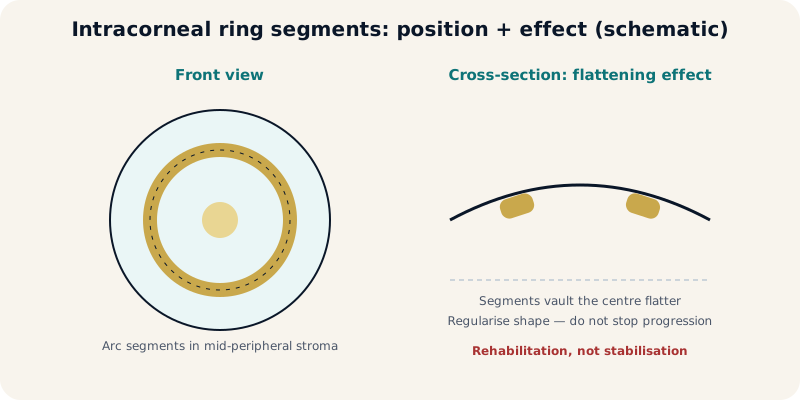
Rings sit in a mid-peripheral stromal tunnel — created with femtosecond assistance where available — and redistribute tension so the cone flattens, reducing irregular astigmatism without removing corneal tissue.
What rings do not do
- They do not strengthen collagen or stop progression — cross-linking is the stabilising procedure.
- They do not restore a fully normal cornea or remove dense central scars.
- They do not suit every eye: selection depends on thickness, morphology, cone location and clarity.

Patient Selection and Planning
- Thickness and morphology: adequate thickness at the tunnel site and a definable cone that benefits from flattening.
- Cone location: central and paracentral cones usually respond best.
- Clarity: dense central scarring limits visual benefit.
- Stability: with documented progression, cross-linking is discussed first or in sequence — decided per eye.
- Realistic expectations: better regularity and lens tolerance, not guaranteed independence.
Ring types and geometry (in general terms)
Rings vary in arc length, thickness and diameter; the surgeon selects the combination from tomography maps. Commercial details are discussed in clinic according to availability and approval.
Sequencing With Cross-Linking
The clinical rationale: cross-linking first when progression requires it, then reassess the need for rings after stabilisation; in selected eyes rings come first, then cross-linking — or customised combined approaches. There is no single rule for all eyes.
Risks and Postoperative Care
- Temporary pain, light sensitivity and healing time.
- Ring migration, extrusion or infection (urgent if suspected).
- Suboptimal visual result; removal or exchange when medically indicated.
- Continued progression if stabilisation was required but not performed.
FAQs
Do corneal rings stop keratoconus?
No — visual rehabilitation. Halting progression is the role of cross-linking.
Will I be free of glasses or lenses?
Not guaranteed; most patients still need correction, but of better quality.
Can rings be removed?
Yes — removable or exchangeable when medically indicated, decided surgically.
Are rings an alternative to transplantation?
In selected eyes they may defer it, but not when severe scarring mandates a graft.
Related topics
Author: Prof. Dr. Amr Said — Assistant Professor of Ophthalmology, Alexandria University. Published November 2026. Educational content; not a substitute for individual assessment.
Are Rings Right for Your Eye?
Assessment starts with Pentacam and a full examination — Smouha and Amreya, Alexandria.
Prof. Dr. Amr Said Cornea & Refractive Surgery Clinic
Prof. Dr. Amr Said — Assistant Professor of Ophthalmology, Faculty of Medicine, Alexandria University; consultant in corneal and refractive surgery, keratoconus treatment and cataract surgery.
Smouha branch: 5 Dr Sayed Fahmy Street, off Bahaa El-Din Ghatwary Street, Smouha — behind Sidi Gaber railway station. Branch map
Amreya branch: In front of Amreya bridge — Omar El-Mokhtar Tower, 3rd floor, Amreya. Branch map
Phones: 01226154154 · 01032037199 · 01021031651 · Amreya: 01096615751
WhatsApp consultation Call: 01226154154 Patient reviews
Working hours and consultation fees are subject to updates — please confirm your appointment and fee by phone or WhatsApp before attending.