Advanced Intraocular Lens (IOL) Selection in Cataract Surgery
An intraocular lens (IOL) is the clear artificial lens that replaces the clouded natural lens during cataract surgery. Prof. Dr. Amr Said performs phacoemulsification cataract surgery in Alexandria and chooses between five IOL categories: monofocal, enhanced monofocal, toric, EDOF and multifocal/trifocal. No category is best for everyone. The lens is chosen after measuring the eye, checking the cornea, ocular surface and retina, and discussing your daily visual needs.
Written by Prof. Dr. Amr Said · Medically reviewed: 6 November 2026
Quick answers At a glance
Which surgical technique is used?
Phacoemulsification. The cloudy lens is broken up with ultrasound and removed through a small incision, and a foldable IOL is placed in the lens capsule. Femtosecond laser-assisted cataract surgery is not offered at the clinic.
Which IOL categories are available?
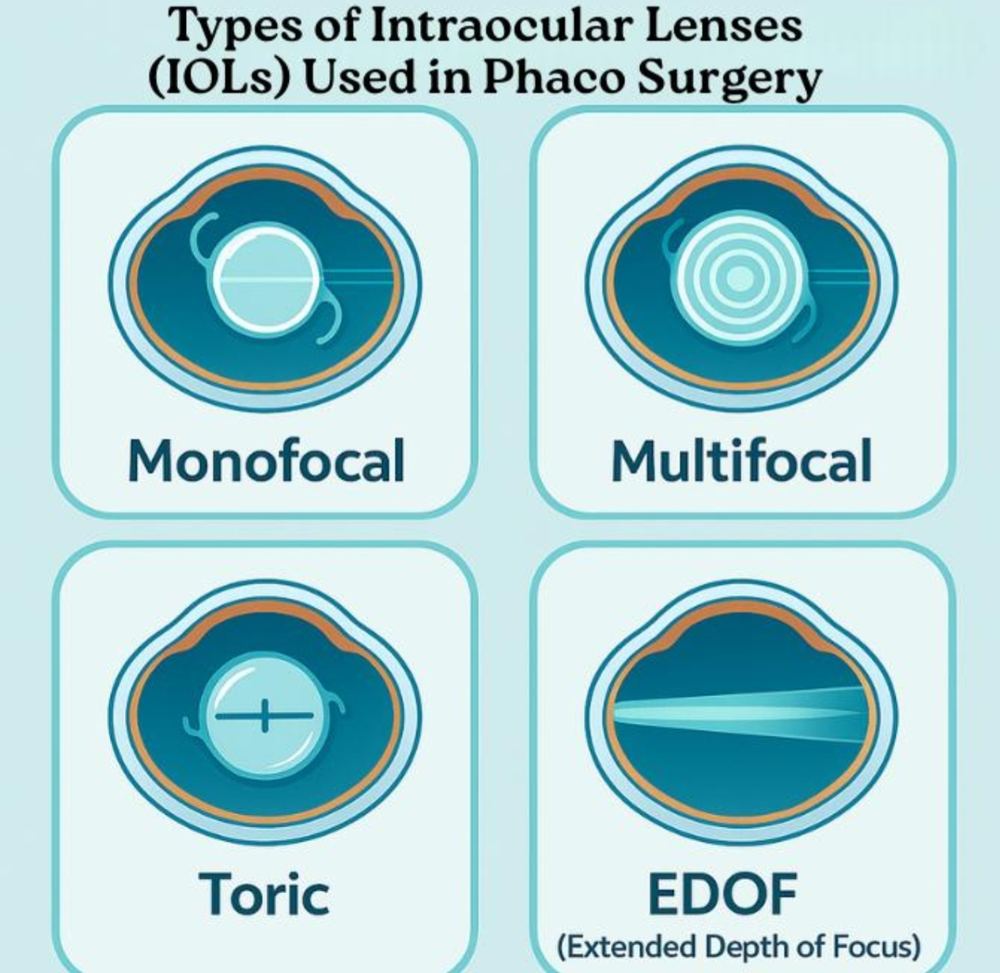
Monofocal, enhanced monofocal, toric, EDOF (extended depth of focus) and multifocal/trifocal. Toric correction can be combined with other designs where suitable.
Which lens is best?
There is no single best lens. Each category trades range of vision against image quality and the chance of halos or glare. The right balance depends on your eye and your priorities.
Will I be free of glasses?
No lens can guarantee this. Some designs may reduce dependence on glasses, but many patients still use them for some tasks.
What is an intraocular lens?
The natural lens inside the eye focuses light onto the retina. When it becomes cloudy (a cataract), vision becomes blurred, dull or glary. In cataract surgery the cloudy lens is removed and replaced with an intraocular lens (IOL). This is a small, clear, permanent artificial lens that usually sits inside the natural lens capsule.
At the clinic, cataract surgery is performed with phacoemulsification. Through a small incision, an ultrasound probe breaks up and removes the cloudy lens, and a foldable IOL is injected into the capsule, where it unfolds. More detail on the operation itself is on the cataract surgery page.
Every IOL has a power, which is calculated from measurements of your eye, and an optical design, which sets how it spreads focus across distance, intermediate and near. The design is what separates the five categories described below. A lens is not meant to be changed later, so the choice is planned carefully before surgery.
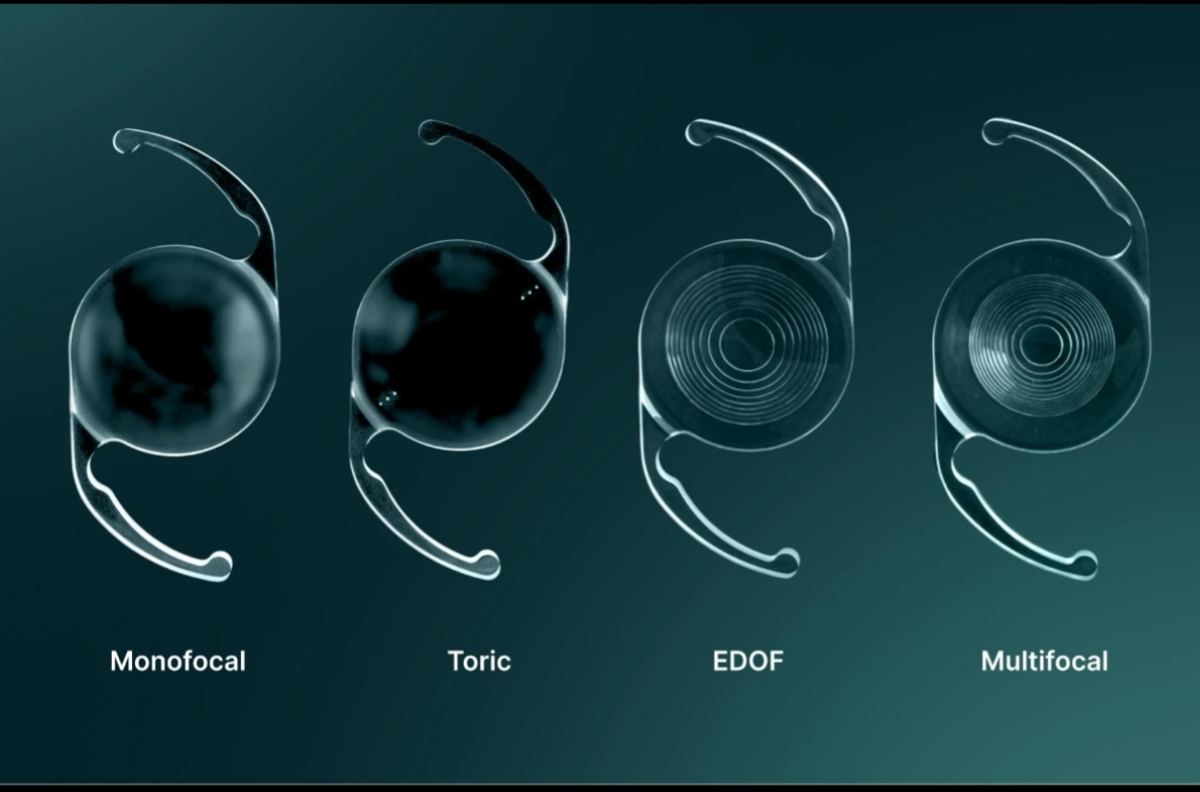
About the technique: the clinic performs phacoemulsification cataract surgery. Femtosecond laser-assisted cataract surgery is not currently offered. The choice of IOL category does not depend on the laser, and all five categories are implanted with phacoemulsification.
Monofocal versus enhanced monofocal lenses
A standard monofocal IOL focuses clearly at one distance. Usually this is far, for driving, walking and television. It gives a high-contrast image with the lowest likelihood of halos, and it is the most established IOL design. Glasses are normally needed for reading and often for computer work. Some patients choose monovision, with one eye set for distance and the other slightly near. This should be discussed and, where possible, tested beforehand, because not everyone adapts to it.
An enhanced monofocal IOL is still a monofocal lens, but its optical profile is modified to stretch the range of focus a little beyond a standard monofocal. It does not split light into separate focal points. The aim is somewhat better intermediate vision, such as a car dashboard or a screen at arm's length, while keeping a visual side-effect profile close to that of a standard monofocal. Reading glasses are usually still needed for near. "Enhanced monofocal" is not one standardised design, so the effect varies between lenses.
Toric IOLs and astigmatism correction
Astigmatism means the cornea is curved more steeply in one direction than another, which blurs vision at all distances. A toric IOL contains extra cylindrical power that can neutralise regular corneal astigmatism. It must be aligned to a planned axis inside the eye, and its marks guide that alignment during surgery.
- Accurate measurement: the amount and axis of astigmatism are measured with several devices and compared. Where indicated, corneal tomography includes the back surface of the cornea, which also contributes to total astigmatism.
- Stability: the astigmatism must be stable and the ocular surface healthy, because dry eye can distort the readings.
- Combination: toric correction is available in monofocal designs and in some extended-range designs.
- Limits: irregular astigmatism, as in moderate or advanced keratoconus or corneal scarring, cannot be fully corrected by a toric lens. Very low astigmatism may not need one. If a toric lens rotates after surgery, its effect falls, and it occasionally needs repositioning.
For irregular corneas, see cataract with irregular astigmatism and cataract surgery in keratoconus.
EDOF (extended depth of focus) lenses
An EDOF IOL creates an elongated focal range instead of a single sharp focus point. The aim is good distance vision with continuous, useful intermediate vision, such as a computer, a phone at arm's length or cooking. Near vision for fine print is often limited, and light reading glasses may still be needed.
Compared with multifocal designs, EDOF lenses are generally associated with fewer halos, although some halos, glare or a small loss of contrast can still occur, depending on the design. They require a healthy macula and a reasonably regular cornea, and some designs are less tolerant of residual refractive error than a monofocal lens.
Multifocal and trifocal lenses
A multifocal IOL divides incoming light between two focal points (bifocal) or three (trifocal) for distance, intermediate and near. It offers the greatest potential to reduce dependence on glasses across daily activities.
Because light is shared between foci, these lenses carry a higher chance of halos and glare around lights at night and some reduction in contrast sensitivity. The brain usually needs a period of adaptation (neuroadaptation), which can take weeks to months. A multifocal lens performs best in an otherwise healthy eye, with a regular cornea, a healthy macula and optic nerve, and a stable tear film. It also suits patients who accept the trade-offs in exchange for less dependence on glasses.
Comparison of the five IOL categories
The table summarises the typical design intent of each category. Actual vision depends on the specific lens, your eye's health, the accuracy of measurements and how you adapt. The table is a starting point for discussion, not a recommendation.
| IOL category | Main visual target | Potential benefits | Main limitations | Glasses afterwards | Often suitable for |
|---|---|---|---|---|---|
| Monofocal | One distance (usually far) | High contrast, fewest halos, well-established predictability | No useful range beyond the chosen distance | Usually needed for near and often intermediate | Most eyes, including those with retinal, optic nerve or corneal disease |
| Enhanced monofocal | Distance with some intermediate | Slightly wider range than standard monofocal, similar side-effect profile in many designs | Modest effect that varies by design | Usually needed for near | Patients wanting a little more intermediate range without multifocal optics |
| Toric | Corrects regular corneal astigmatism, combined with the chosen focus design | Sharper uncorrected vision when astigmatism is significant and regular | Needs accurate axis alignment; rotation reduces effect; not for irregular corneas | Depends on the base design | Meaningful, stable, regular astigmatism |
| EDOF | Distance and intermediate | Continuous range to arm's length, generally fewer halos than multifocal designs | Near may be limited; some halos, glare or contrast loss possible | Light reading glasses often needed for fine print | Healthy eyes with high intermediate needs (screens, daily tasks) |
| Multifocal / trifocal | Distance, intermediate and near | Greatest potential reduction in dependence on glasses | Halos and glare, reduced contrast, need for adaptation | Many patients need them rarely, but some still do | Otherwise healthy eyes, regular cornea, realistic expectations |
Benefits and limitations of each lens type
Monofocal
- Benefits
- Crisp, high-contrast vision at the chosen distance; lowest rate of halos; most tolerant of other eye conditions.
- Limitations
- Glasses are expected for other distances unless monovision is planned and tolerated.
Enhanced monofocal
- Benefits
- A modest gain in intermediate vision with a visual-quality profile close to a standard monofocal.
- Limitations
- Reading glasses are usually still needed; the benefit varies between designs.
Toric
- Benefits
- Reduces regular corneal astigmatism, which can sharpen uncorrected vision at the target distance.
- Limitations
- Depends on precise measurement and alignment; cannot correct irregular astigmatism.
EDOF
- Benefits
- Extended range from distance to intermediate, generally with fewer halos than multifocal lenses.
- Limitations
- Near vision may be limited; some halos or contrast reduction remain possible.
Multifocal / trifocal
- Benefits
- The widest designed range, with the greatest potential for reduced dependence on glasses.
- Limitations
- More halos and glare, reduced contrast, an adaptation period, and less tolerance of other eye disease.
Patient suitability and contraindications
Suitability is decided per eye after examination. The factors below often lead to a recommendation for a monofocal or enhanced monofocal lens, or to extra caution with extended-range and multifocal designs. They are relative considerations, not absolute rules.
- Macular disease: age-related macular degeneration, epiretinal membrane, diabetic macular oedema or other macular changes may reduce the benefit of multifocal and some EDOF designs.
- Glaucoma or optic nerve disease: reduced contrast sensitivity makes lenses that share light less attractive, especially in advanced disease.
- Irregular cornea: keratoconus, corneal scarring, corneal transplant or decentred previous laser treatment can degrade image quality with multifocal optics and make toric correction unreliable.
- Ocular surface disease: significant dry eye or blepharitis can distort measurements and reduce visual quality. It is often treated before final measurements.
- Pupil, capsule and zonules: a very small or very large pupil, weak lens support (zonules) or capsule problems can affect lens choice and centration.
- Lifestyle and personality: frequent night driving, highly detailed visual work, or a low tolerance for halos may favour monofocal-based options. Unrealistic expectations of being completely free of glasses are a reason to reconsider multifocal lenses.
Please note: being unsuitable for one category does not mean being unsuitable for cataract surgery. A monofocal lens, with or without toric correction, can give good vision in many eyes where other designs are not advised.
Halos, glare and dependence on glasses
Halos are rings seen around lights, and glare is scattered brightness that makes lights harder to look at, mostly at night. They can follow any cataract operation in the early weeks. They are more common and more persistent with designs that split or extend focus, especially multifocal and trifocal lenses. For many patients they become less noticeable as the brain adapts, but they do not disappear for everyone.
Dependence on glasses after surgery depends on the lens category, the target chosen, any remaining astigmatism or prescription, and the health of the eye. As a general pattern, the wider the designed range of a lens, the lower the potential need for glasses, but the higher the chance of night-time visual side effects. Choosing an IOL is therefore a balance between range of vision and visual quality, and it should reflect what matters most to you.
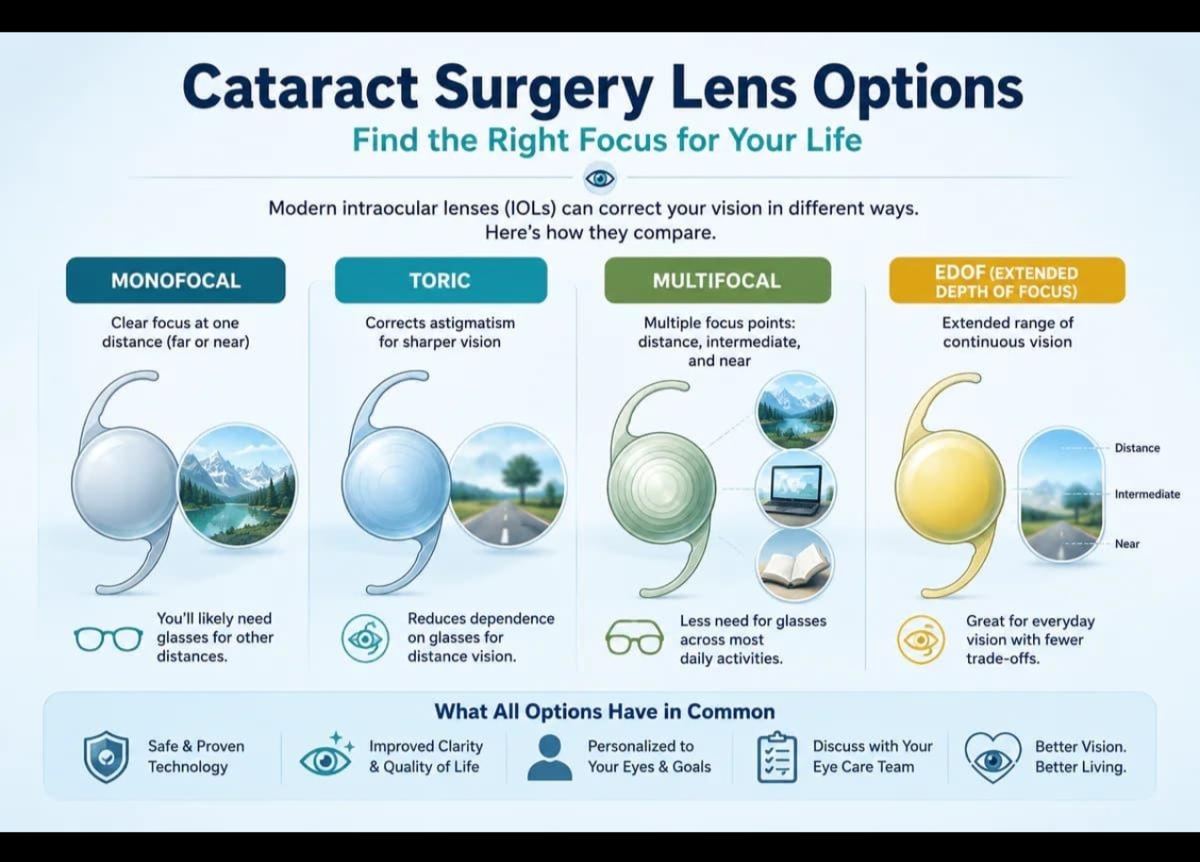
Residual prescription after surgery can sometimes be refined with glasses, contact lenses or, in selected cases, a corneal laser enhancement. This is considered only after vision has stabilised.
Corneal and retinal assessment before IOL selection
The lens is chosen from measurements, not from a brochure. Assessment usually includes the following, tailored to each eye:
| Assessment | What it measures | How it can influence the IOL choice |
|---|---|---|
| Optical biometry | Eye length, anterior chamber depth and other dimensions | Used to calculate the IOL power |
| Keratometry | Corneal power and astigmatism | Shows whether a toric lens is needed, and its power and axis |
| Corneal tomography / topography | Front and back corneal shape, regularity and thickness | Detects keratoconus, irregularity or previous laser treatment that may rule out multifocal or toric designs |
| Ocular surface and tear film evaluation | Dry eye and surface stability | An unstable surface may be treated first and measurements repeated |
| Macular OCT (when indicated) | Cross-sectional scan of the central retina | Macular disease may favour a monofocal rather than a multifocal lens |
| Dilated retina and optic nerve examination | Retinal and optic nerve health | Glaucoma or retinal disease may limit premium-design options |
Read more about advanced corneal diagnostics and the role of corneal tomography in cataract planning. Ocular surface preparation is explained in ocular surface optimisation before premium IOL implantation.
Cataract after LASIK or PRK
Laser vision correction (LASIK, PRK or SMILE) changes the shape of the cornea. Standard IOL formulas assume a typical cornea, so after refractive surgery they can miscalculate the lens power and leave an unexpected prescription.
- Adjusted calculations: specific post-refractive methods and formulas are used and cross-checked, and earlier refractive records help when available.
- Corneal mapping: tomography checks how centred and regular the previous treatment is, which affects whether extended-range or multifocal optics are sensible.
- Lens choice: monofocal, enhanced monofocal, toric or some extended-range lenses can work well in suitable post-LASIK eyes. Multifocal designs need extra caution, because the treated cornea may already add optical aberrations.
- Expectations: the chance of a residual prescription is higher than in an untreated eye, and patients are told this before surgery.
More detail: cataract surgery after LASIK or PRK and IOL power calculation after refractive surgery. Patients with keratoconus can read keratoconus treatment and cataract surgery in keratoconus.
Personalised IOL planning and consultation
Lens selection is a shared decision between you and your surgeon. A typical consultation works through these steps:
- Your priorities: which distances matter most (driving, screens, reading, hobbies), how you feel about glasses, and how much night driving you do.
- Your eye's health: examination and measurements of the cornea, ocular surface, retina and optic nerve, plus any previous eye surgery.
- Matching options: the categories that suit your eye are explained, with their realistic benefits and trade-offs. Categories that are not advisable are explained too.
- Target and power: the refractive target (for example distance, or a planned monovision) is agreed, and the lens power is calculated, with toric planning if needed.
- Second eye: the plan for the second eye can be refined according to the result and your experience in the first.
Visual recovery varies between patients and depends on their individual eye condition. Adaptation to EDOF and multifocal optics can take longer, and follow-up visits check healing and the final prescription. For the full surgical pathway, see the cataract surgery page. Further reading on lens categories in Arabic: types of modern intraocular lenses.
Questions about choosing an IOL
What is the best intraocular lens for cataract surgery?
There is no single best lens. Monofocal, enhanced monofocal, toric, EDOF and multifocal/trifocal lenses each balance range of vision against visual quality differently. The most suitable lens depends on your measurements, cornea, retina and visual priorities, and is chosen after examination.
What is the difference between a monofocal and an enhanced monofocal lens?
Both focus mainly at one distance, usually far. An enhanced monofocal has a modified optical profile that slightly extends intermediate vision, without splitting light into separate foci. Reading glasses are usually still needed with both.
Can a toric IOL correct all astigmatism?
No. A toric IOL corrects regular corneal astigmatism when it is accurately measured and aligned. Irregular astigmatism, as in keratoconus or corneal scarring, cannot be fully corrected by a toric lens, and very small amounts may not need one.
Is an EDOF lens the same as a multifocal lens?
No. An EDOF lens extends one continuous focal range, mainly for distance and intermediate vision. A multifocal or trifocal lens divides light between separate foci, including near. EDOF lenses generally cause fewer halos, while multifocal lenses usually give more near vision.
Will I see halos with a multifocal or trifocal lens?
Halos and glare around lights at night are possible with multifocal and trifocal lenses and are more common than with monofocal lenses. Many patients find them less noticeable over time as the brain adapts, but this varies and they may persist for some people.
Will I need glasses after cataract surgery?
It depends on the lens and your eye. With a monofocal lens, glasses are usually needed for near. Extended-range and multifocal designs may reduce dependence on glasses, but no lens can guarantee freedom from them.
Can I have a multifocal lens after LASIK or PRK?
Sometimes, but it requires extra caution. The treated cornea may already add aberrations, and lens power is harder to calculate. Corneal tomography and adjusted formulas guide the decision, and monofocal-based options are often preferred.
Is femtosecond laser cataract surgery needed for premium lenses?
No. All five IOL categories are implanted with phacoemulsification. The clinic performs phacoemulsification and does not currently offer femtosecond laser-assisted cataract surgery.
Can the lens be changed later?
An IOL is intended to be permanent. Exchange is possible in rare situations but carries additional surgical risk, which is why the choice is planned carefully beforehand.

Written and medically reviewed by: Prof. Dr. Amr Said — Assistant Professor of Ophthalmology, Faculty of Medicine, Alexandria University; consultant in corneal and refractive surgery, keratoconus management and cataract surgery.
Professional profile · Research & publications
Last reviewed: 6 November 2026
This information is for patient education and is not a diagnosis or a recommendation of any specific lens. No lens brands, prices or guaranteed outcomes are implied. The intraocular lens is chosen after a personal examination, measurements and a discussion of your needs.
Scientific references
Published sources for further reading. This page is for education and does not replace a medical examination.
- Miller KM, Oetting TA, Tweeten JP, et al. Cataract in the Adult Eye Preferred Practice Pattern. Ophthalmology. 2022;129(1):P1–P126. doi.org/10.1016/j.ophtha.2021.10.006
- de Silva SR, Evans JR, Kirthi V, Ziaei M, Leyland M. Multifocal versus monofocal intraocular lenses after cataract extraction. Cochrane Database Syst Rev. 2016;12:CD003169. doi.org/10.1002/14651858.CD003169.pub4
- Kessel L, Andresen J, Tendal B, Erngaard D, Flesner P, Hjortdal J. Toric intraocular lenses in the correction of astigmatism during cataract surgery: a systematic review and meta-analysis. Ophthalmology. 2016;123(2):275–286. doi.org/10.1016/j.ophtha.2015.10.002
- Visser N, Bauer NJ, Nuijts RM. Toric intraocular lenses: historical overview, patient selection, IOL calculation, surgical techniques, clinical outcomes, and complications. J Cataract Refract Surg. 2013;39(4):624–637. doi.org/10.1016/j.jcrs.2013.02.020
- Kohnen T, Suryakumar R. Extended depth-of-focus technology in intraocular lenses. J Cataract Refract Surg. 2020;46(2):298–304. doi.org/10.1097/j.jcrs.0000000000000109
- Braga-Mele R, Chang D, Dewey S, et al. Multifocal intraocular lenses: relative indications and contraindications for implantation. J Cataract Refract Surg. 2014;40(2):313–322. doi.org/10.1016/j.jcrs.2013.12.011
- Koch DD, Ali SF, Weikert MP, Shirayama M, Jenkins R, Wang L. Contribution of posterior corneal astigmatism to total corneal astigmatism. J Cataract Refract Surg. 2012;38(12):2080–2087. doi.org/10.1016/j.jcrs.2012.08.036
- Wang L, Hill WE, Koch DD. Evaluation of intraocular lens power prediction methods using the American Society of Cataract and Refractive Surgeons Post-Keratorefractive Intraocular Lens Power Calculator. J Cataract Refract Surg. 2010;36(9):1466–1473. doi.org/10.1016/j.jcrs.2010.03.044
- American Society of Cataract and Refractive Surgery (ASCRS). Post-Refractive IOL Calculator (online resource for surgeons). iolcalc.ascrs.org/
- Kane JX, Connell B, Yip H, et al. Accuracy of intraocular lens power formulas modified for patients with keratoconus. Ophthalmology. 2020;127(8):1037–1042. doi.org/10.1016/j.ophtha.2020.02.008
- Watson MP, Anand S, Bhogal M, et al. Cataract surgery outcome in eyes with keratoconus. Br J Ophthalmol. 2014;98(3):361–364. doi.org/10.1136/bjophthalmol-2013-303829
- Starr CE, Gupta PK, Farid M, et al. An algorithm for the preoperative diagnosis and treatment of ocular surface disorders. J Cataract Refract Surg. 2019;45(5):669–684. doi.org/10.1016/j.jcrs.2019.03.023
- Epitropoulos AT, Matossian C, Berdy GJ, Malhotra RP, Potvin R. Effect of tear osmolarity on repeatability of keratometry for cataract surgery planning. J Cataract Refract Surg. 2015;41(8):1672–1677. doi.org/10.1016/j.jcrs.2015.01.016
Book a Cataract & IOL Assessment
The right lens cannot be chosen from a generic online recommendation. It depends on your eye measurements, corneal and retinal health, and your daily visual needs. Book a personal assessment, send us a WhatsApp enquiry or call the clinic.
🕐 Sun, Mon & Thu: 1–5 pm | Wed: 3–7 pm
🕐 Sat: 12–7 pm | Tue: 5–7 pm
Tests are arranged according to your case; when you book, we confirm where each test is performed.