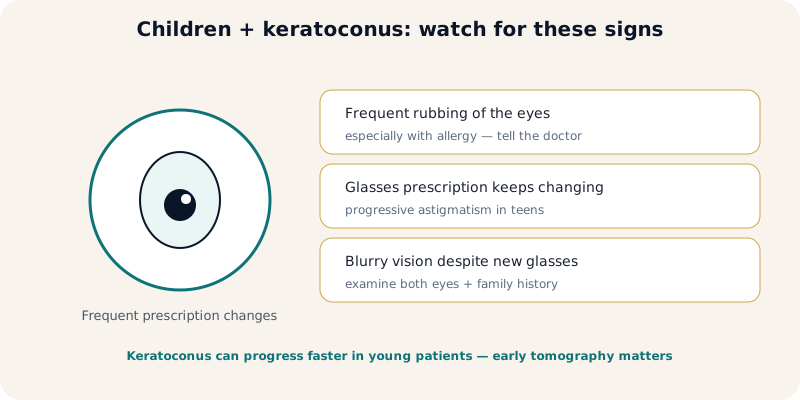
Why Childhood Keratoconus Needs Special Attention
- Younger onset leaves more years for progression and often a faster course.
- Children rub itchy allergic eyes vigorously — the key modifiable trigger.
- Complaints may be vague ("I can't see the board"), so adults must watch for the signs.
Early Warning Signs for Parents
- Unexplained repeated changes of glasses prescription, rising astigmatism.
- Squinting, sitting close to screens, declining school performance.
- Constant eye rubbing, allergic eye disease, family history of keratoconus.
- One eye noticeably worse than the other.
Diagnosis: Gentle but Thorough
Pentacam tomography is the cornerstone, read exactly as in adults (reading guide), with two paediatric caveats: obtaining reliable measurements can be harder in young children, and both eyes are always examined. Siblings of a diagnosed child deserve baseline imaging.
Treatment: Individual, Never Automatic
- Observation with short-interval monitoring is right for many: stable, mild, well-corrected cases.
- Cross-linking is discussed when progression is documented or risk is high — weighing age, thickness and severity; techniques guide.
- Specialty lenses rehabilitate vision without touching progression — lens guide.
- Rings and transplantation are reserved for selected and advanced cases respectively.
- No rigid age cut-off decides treatment; the eye's measurements and history do.
Parent FAQ
Will my child go blind?
Blindness is rare; with early detection, monitoring and timely stabilisation, most children keep functional vision. Delay is the real enemy.
Can my child wear contact lenses?
Often yes, fitted individually — lenses improve optics while monitoring continues.
Should brothers and sisters be checked?
Yes — baseline corneal imaging for siblings is recommended.
How do we stop the rubbing?
Treat the allergy cause with the doctor, keep nails short, and explain the link to your child in simple words.
Selected references: Gomes JAP et al. Global consensus on keratoconus and ectatic diseases. Cornea. 2015;34(4):359–369. · Rabinowitz YS. Keratoconus. Surv Ophthalmol. 1998;42(4):297–319.
Related topics
Author: Prof. Dr. Amr Said — Assistant Professor of Ophthalmology, Faculty of Medicine, Alexandria University. Published November 2026. Last medical review: November 2026. Educational content; not a substitute for individual assessment.
Prof. Dr. Amr Said Cornea & Refractive Surgery Clinic
Prof. Dr. Amr Said — Assistant Professor of Ophthalmology, Faculty of Medicine, Alexandria University; consultant in corneal and refractive surgery, keratoconus treatment and cataract surgery.
Smouha branch: 5 Dr Sayed Fahmy Street, off Bahaa El-Din Ghatwary Street, Smouha — behind Sidi Gaber railway station. Branch map
Amreya branch: In front of Amreya bridge — Omar El-Mokhtar Tower, 3rd floor, Amreya. Branch map
Phones: 01226154154 · 01032037199 · 01021031651 · Amreya: 01096615751
Working hours and consultation fees are subject to updates — please confirm your appointment and fee by phone or WhatsApp before attending.