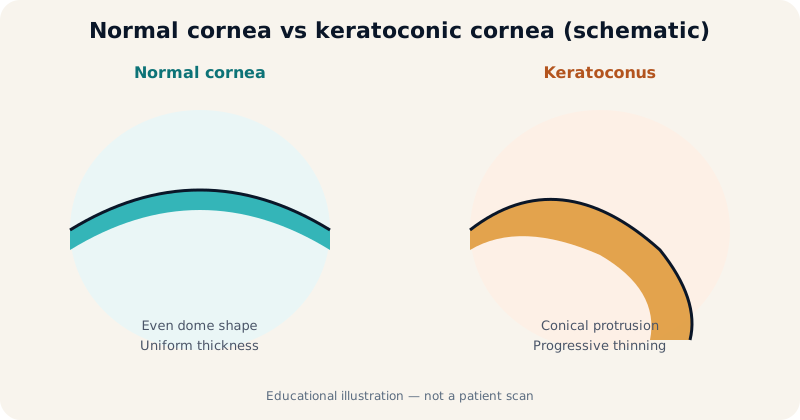
What Is Keratoconus?
The healthy cornea is an evenly domed transparent window. In keratoconus the collagen weakens, the centre thins and bulges forward into an irregular cone, scattering light before it reaches the retina. Glasses help early on but stop being enough as irregularity grows — the famous complaint: "I see with glasses, but the picture is never sharp."
Causes and Risk Factors
- Genetics and family history: relatives of patients carry higher risk and deserve screening imaging.
- Eye rubbing and allergy: chronic rubbing is the most important modifiable risk factor — treat the allergy, stop the rubbing.
- Age of onset: typically teens to twenties; younger onset often means faster change and needs closer follow-up.
Read more: Pentacam diagnosis guide.
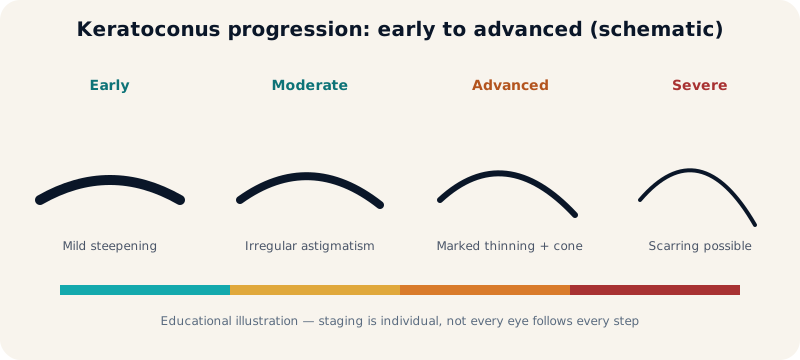
Early Symptoms Patients Notice
- Frequent glasses prescription changes, especially rising astigmatism.
- Ghosting, halos around lights, poor night vision.
- One eye clearly worse than the other; rubbing itchy eyes.
How Is It Diagnosed?
Refraction plus slit-lamp examination raise suspicion; Pentacam tomography confirms the pattern (anterior/posterior curvature, thickness distribution, elevation) — never one number alone. The fellow eye is always imaged too.
The Treatment Path in Order
- 1. Optical rehabilitation: glasses, then specialty lenses (RGP, hybrid, scleral) — they improve quality but do not stop progression.
- 2. Stabilisation: cross-linking when progression is documented — it halts weakening; visual improvement is not guaranteed.
- 3. Regularisation: intracorneal rings for selected irregular corneas.
- 4. Replacement: corneal transplantation (DALK vs PK) for advanced scarred disease.
FAQs
Does keratoconus affect one eye or both?
Usually both, asymmetrically; a currently normal fellow eye still needs periodic imaging.
Does it cause blindness?
Total blindness is rare, but advanced disease severely limits correctable vision — hence early detection.
Can I have LASIK if I have keratoconus?
No — LASIK is contraindicated in keratoconus; it removes tissue from an already weak cornea.
Is it hereditary? Should my children be checked?
Risk runs in families; children of patients benefit from early screening — children's guide.
Selected references: Rabinowitz YS. Keratoconus. Surv Ophthalmol. 1998;42(4):297–319. · Gomes JAP et al. Global consensus on keratoconus and ectatic diseases. Cornea. 2015;34(4):359–369.
Related topics
Author: Prof. Dr. Amr Said — Assistant Professor of Ophthalmology, Faculty of Medicine, Alexandria University. Published November 2026. Last medical review: November 2026. Educational content; not a substitute for individual assessment.
Prof. Dr. Amr Said Cornea & Refractive Surgery Clinic
Prof. Dr. Amr Said — Assistant Professor of Ophthalmology, Faculty of Medicine, Alexandria University; consultant in corneal and refractive surgery, keratoconus treatment and cataract surgery.
Smouha branch: 5 Dr Sayed Fahmy Street, off Bahaa El-Din Ghatwary Street, Smouha — behind Sidi Gaber railway station. Branch map
Amreya branch: In front of Amreya bridge — Omar El-Mokhtar Tower, 3rd floor, Amreya. Branch map
Phones: 01226154154 · 01032037199 · 01021031651 · Amreya: 01096615751
Working hours and consultation fees are subject to updates — please confirm your appointment and fee by phone or WhatsApp before attending.