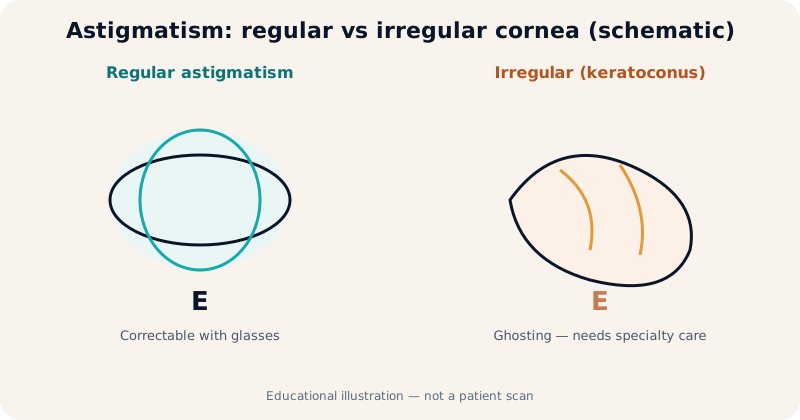
The Two Types: Regular and Irregular
| Aspect | Regular astigmatism | Irregular astigmatism |
|---|---|---|
| Shape | Even oval curvature with two clear axes | Uneven surface with no clear axes |
| Common causes | Mostly congenital and stable | Keratoconus, scars, post-surgical or post-injury change |
| Glasses | Usually correct it well | Alone insufficient; vision improves but never clears |
| Plan | Glasses, toric lenses, or LASIK with conditions | Corneal imaging, then specialty lenses, cross-linking or rings per cause |
Symptoms Worth Noting
- Blurred vision at all distances, eye strain and headache with concentration.
- Ghosting or doubling of letters, especially at night and around lights.
- Warning signs: rapidly changing glasses prescription, deteriorating vision despite updates, frequent eye rubbing at a young age — all warrant corneal imaging.
Diagnosis: More Than a Glasses Test
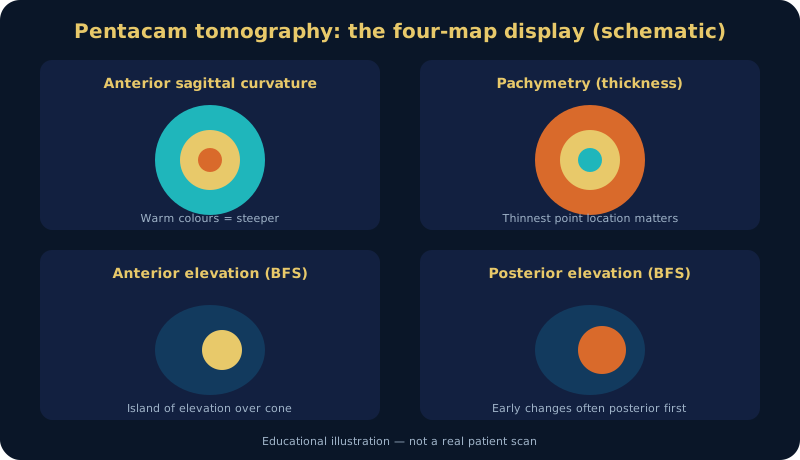
Refraction measures the degree but never reveals the cause. Full diagnosis includes visual acuity, slit-lamp examination and Pentacam corneal imaging whenever irregularity is suspected. How are the maps read?
Treatment Options by Cause
- Glasses and soft toric lenses: for simple stable regular astigmatism.
- Specialty lenses (rigid/hybrid/scleral): for irregularity — lens guide.
- LASIK and vision correction: for regular astigmatism only, with a healthy stable cornea after excluding keratoconus — LASIK assessment.
- Cross-linking, rings and transplantation: when the cause is progressive keratoconus — cross-linking · rings · transplantation.
FAQs
Does astigmatism increase over time?
Congenital regular astigmatism is usually stable; rapid increase — especially in teenagers — warrants corneal imaging to exclude keratoconus.
Can astigmatism be cured permanently?
Regular astigmatism is corrected by glasses, lenses or LASIK with its conditions; irregular astigmatism is managed per cause — no single fix fits all.
My child rubs his eyes and the prescription keeps changing — should I worry?
Yes, it deserves early examination and corneal imaging; eye rubbing is a risk factor and early detection changes the plan — keratoconus in children.
Are regular contact lenses enough for irregularity?
Usually not; an irregular surface needs rigid or scleral lenses that create a new optical surface.
Selected references: Rabinowitz YS. Keratoconus. Surv Ophthalmol. 1998;42(4):297–319. · Gomes JAP et al. Global consensus on keratoconus and ectatic diseases. Cornea. 2015;34(4):359–369.
Related topics
Author: Prof. Dr. Amr Said — Assistant Professor of Ophthalmology, Faculty of Medicine, Alexandria University. Published November 2026. Last medical review: November 2026. Educational content; not a substitute for individual assessment.
Prof. Dr. Amr Said Cornea & Refractive Surgery Clinic
Prof. Dr. Amr Said — Assistant Professor of Ophthalmology, Faculty of Medicine, Alexandria University; consultant in corneal and refractive surgery, keratoconus treatment and cataract surgery.
Smouha branch: 5 Dr Sayed Fahmy Street, off Bahaa El-Din Ghatwary Street, Smouha — behind Sidi Gaber railway station. Branch map
Amreya branch: In front of Amreya bridge — Omar El-Mokhtar Tower, 3rd floor, Amreya. Branch map
Phones: 01226154154 · 01032037199 · 01021031651 · Amreya: 01096615751
Working hours and consultation fees are subject to updates — please confirm your appointment and fee by phone or WhatsApp before attending.